

Reviewed · WALKING TOURS IN SICILY
Catania Walking Tour with Audio and Written Guide by a Local
Catania’s story comes into focus on this self-guided walk, which links a lava-stone castle, a noisy fish market, Baroque churches, and Roman ruins in one route across the historic center. The guide works on your smartphone, so you can stop when something catches your eye and pick up the route again when you’re ready.
I like two things in particular: the route gives you a clear path between major sights, including corners you might otherwise miss, and the audio and written guide let you explore at your own speed. At $7.83, it’s also a modest way to add context to a day of wandering.
The main consideration is that this is not a walk with a guide in person. You’ll need a smartphone with internet access, and one visitor found the Ursino Castle starting point inconveniently far from where they had already walked, so check the route before setting off.
- Nine stops, from Ursino Castle to the Benedictine Monastery: The route crosses Catania’s historic center and takes about three to four hours.
- A flexible phone-based guide: Audio and written commentary are available in English, Spanish, Italian, German, and French.
- A mix of city life and history: You’ll pass the fish market, the cathedral, an ancient Roman amphitheater, and Baroque streets.
- One optional paid stop: Entry to the Roman amphitheater costs €4, and is not included.
- Good value for independent explorers: At $7.83 per person, you get a mapped route and local restaurant advice, but no in-person guide.
A walk through Catania, at your own pace

This route gives you a useful first look at Catania’s historic center, with a sequence of sites that spans several periods of the city’s past. The route begins at Ursino Castle and ends at the Benedictine Monastery of San Nicolò l’Arena, but the digital format means you can choose a different ending point.
Plan on about three to four hours, including the listed stops and time to move between them. You can pause for a meal, linger in a square, or skip an attraction that doesn’t interest you. That freedom is the point: the guide provides structure without setting the pace.
You get both audio and written information, and can follow the route through Google Maps. The commentary covers monuments, history, and local curiosities. Restaurant advice is included too, a useful extra when you’d rather eat something local than pick the first place you see.
The guide is offered in five languages: English, Spanish, Italian, German, and French. You’ll need an internet connection to use it, and your voucher contains the activation details. Read those instructions before you leave; a phone-based tour is only convenient once the guide is working.
Starting at Ursino Castle
Ursino Castle is the first stop and has a longer allotted visit than any other site: one hour. It stands in Piazza Federico di Svevia, a broad square named for Frederick II, the Holy Roman Emperor and King of Sicily.
The castle’s setting has changed dramatically over time. It was originally close to the sea, surrounded by a moat and defended by other fortifications. Its outer wall is built from neatly squared lava-stone blocks, while the inner wall is much less regular. Look closely and you can see the contrast in the masonry.
The castle’s name remains uncertain, another small puzzle to keep in mind as you start. The allotted hour gives you room to take in the structure and its setting, though you should check your own plans if you want to spend that long here. The route itself is self-guided, not a scheduled visit led by a person.
Starting here may not suit everyone. One person found the meeting point inconvenient because they had already walked past much of the route to reach it, then had to retrace their steps. If you’re already in the center, check the map before setting out. Since you can use the digital guide independently, you can also adjust where you begin.
More Walking Tours in Sicily
- Catania: Heart of the City Guided Walking Tour
★ 4.6 · 708 reviews - Catania: City Highlights Walking Tour
★ 4.7 · 666 reviews - Catania: Street Food Guided Walking Tour
★ 4.9 · 326 reviews
At the Pescheria, Catania’s fish market

The walk heads next to A’ Piscaria, also known as the Pescheria, Catania’s famous fish market. Locals call it Piscarìa, a word from the Sicilian dialect. It sits near Piazza del Duomo and the Fontana dell’Amenano, bringing the route from a defensive landmark into one of the city’s everyday public places.
The stop is allotted 20 minutes. That’s enough time to get a feel for the market and its place in the historic center, though you may want longer if you’re drawn to the scene. The guide’s practical value here is in placing the market within the surrounding streets and sights, rather than treating it as a quick photo stop.
The route then brings you to the Fontana dell’Amenano, a marble fountain made in 1867 by Neapolitan sculptor Tito Angelini. It is named for the Amenano, an underground river that flows beneath Catania. The visit is short, just 10 minutes, but the fountain gives you a compact introduction to the city’s relationship with water and its hidden layers.
Piazza del Duomo and Sant’Agata’s cathedral
Piazza del Duomo is the city’s central square and one of the most important stops on the walk. You’ll have 20 minutes here, with time to take in the square and its major monuments, including the Cathedral of Sant’Agata.
The cathedral is dedicated to Catania’s patron saint and is a leading example of Baroque architecture. Its history reaches back to 1090, when it was built on the remains of a Roman temple dedicated to Jupiter. The earthquake of 1693 destroyed much of Catania and led to the cathedral’s rebuilding.
That sequence helps explain why the city’s historic center combines remains from different eras. You’re not looking at a single moment frozen in time, but at a place repeatedly shaped by disaster and reconstruction. The guide’s historical notes are useful for making those layers easier to read as you walk.
The stop is listed as free, but the tour information does not detail interior access or opening arrangements. If going inside matters to you, check separately before your visit rather than assuming the timed stop includes a cathedral visit.
Bronze legends at Piazza Università
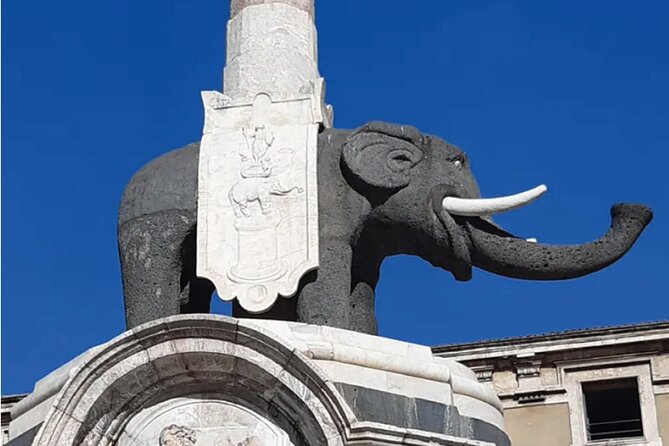
A short walk brings you to Piazza Università, named for the Palazzo degli Studi, also called Palazzo Università. The square’s four bronze lampposts are its distinctive detail. Each represents a character from Catania’s popular legends.
The figures include Gammazita, Cola Pesce, the brothers Anfinomo and Anapia, and the paladin Uzeta. Their stories add a local layer to a place that might otherwise seem like a simple pause between larger attractions. You’ll have 10 minutes here, enough to look at the lampposts and read or listen to the guide’s explanation.
This is the kind of stop that works well in a self-guided format. You don’t need to rush through a major museum, but a little context can turn a passing glance into a memorable detail. If you want to linger, the guide allows you to do so.
More self-guided options in Catania:
- From Catania: Inspector Montalbano Day Tour with Audio Guide
★ 3.5 · 6 reviews - Taormina: Ancient Theater Skip-the-Line Ticket & Audio Guide
★ 4.5 · 1,701 reviews - Agrigento: Valley of the Temples Ticket & App Audioguide
★ 4.3 · 1,160 reviews - Agrigento: Valley of the Temples Entry Ticket & Audio Guide
★ 4.1 · 268 reviews
Roman Catania beneath Piazza Stesicoro

At the Roman Amphitheater, the route brings you to an archaeological site beneath Piazza Stesicoro. The remains date to the first century BC and have been covered over time by Etna’s eruptions and seismic events. The stop is allotted 25 minutes.
You won’t enter as part of the tour. Admission costs an additional €4 if you decide to visit, so budget for that separately. If you’re content to see the site from outside, you can continue without paying the extra fee.
This is one of the route’s clearest trade-offs. The walk provides an introduction to the amphitheater, but it does not include the visit itself. Decide in advance whether you want to go in, especially if you’re keeping your costs tight or working to a schedule.
Via dei Crociferi’s Baroque streetscape

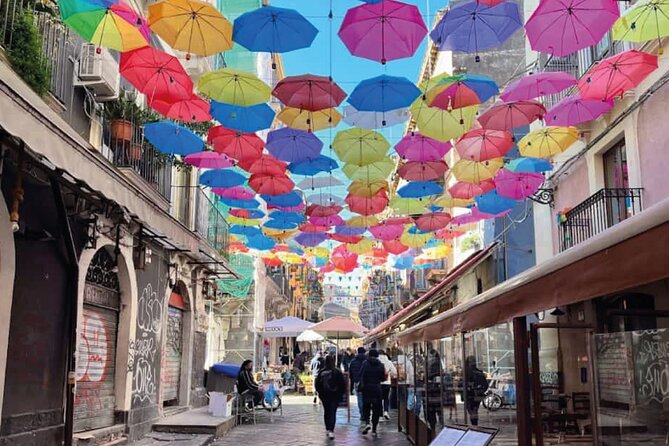
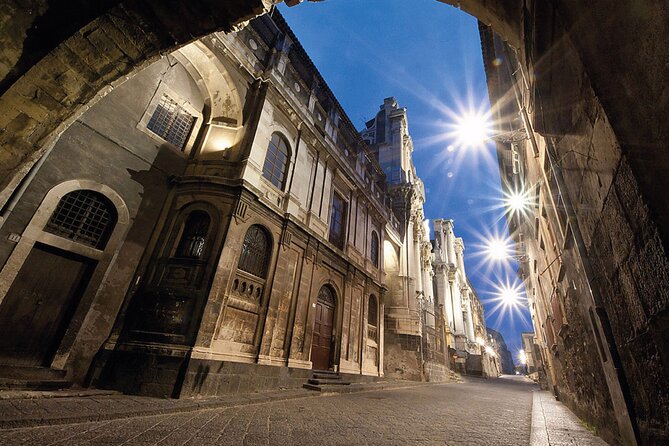
Via dei Crociferi is described as one of Catania’s oldest and most evocative streets. It is known for its beauty and has been chosen as a film location, a detail that makes sense when you see how strongly the street’s setting draws the eye.
The stop is brief, just 10 minutes. That may be enough to appreciate the street and its character, but there’s no need to treat the allotted time as a hard limit. The freedom to pause is one of the better features of an audio guide, particularly on a street where you may want to look around rather than keep moving.
After the market and central square, this stretch offers a different kind of city experience. Here, the buildings and street itself take center stage. The guide gives you a reason to slow down and notice the setting rather than simply using the road to reach the next landmark.
Finishing at the Benedictine Monastery
The final scheduled stop is the Benedictine Monastery of San Nicolò l’Arena, with 30 minutes allotted. The monastery has played an important role in Catania’s history, especially in the eighteenth century. Its grand scale, rich rooms, and the noble backgrounds of the monks who lived there all contributed to its standing.
The route ends at Piazza Dante Alighieri, but the digital guide does not lock you into that endpoint. You can finish elsewhere if you need to head back to your hotel, continue sightseeing, or stop for a meal. That flexibility is useful because the route crosses a good stretch of the historic center.
The monastery makes a fitting last stop after the walk’s changing mix of sites. You’ve moved from a castle and market to a fountain, cathedral, legends, Roman remains, and a major religious complex. The guide gives the route continuity, helping you understand these as parts of one city rather than a collection of unrelated photo stops.
What $7.83 buys you
At $7.83 per person, this is a low-cost way to get a mapped route and commentary for a substantial walk. You’re paying for the digital guide, audio and written content, practical tips on monuments, and advice about authentic local food. You’re not paying for a human guide, transport, or the €4 amphitheater ticket.
That price makes sense if you like exploring independently and want more structure than a map alone. The guide can help you cover the main historic sights efficiently, while still leaving room to choose your own pace. People who enjoy pausing, revisiting information, or making their own detours may find that more useful than following a group.
The flip side is that you’re responsible for operating the guide and navigating the route. You need a smartphone and internet connection, and you may want headphones if you’d rather not listen through your phone’s speakers. Headphones are not included.
The tour is recommended for English speakers, but the guide is also available in four other languages. Group discounts are offered, and the maximum group size is listed as 104. Since this is a digital product rather than an in-person guided walk, that maximum does not mean you’ll be walking with a guide or hearing live commentary.
Practical tips before you set off
Check the activation instructions in your voucher carefully, and make sure you can access the guide before you begin. The instructions are sent with the booking details and again before the activity, but it’s sensible to confirm that your phone is ready rather than troubleshooting on the street.
Review the route on Google Maps before heading to Ursino Castle. If you’re already near another stop, you may prefer to begin there or adjust the order. The guide is designed for independent use, and the endpoint can be changed to suit your day.
Allow three to four hours if you want to follow the route and spend time at the stops. The listed stop times add up to about three hours and 25 minutes, before walking time, so the overall estimate is a useful guide rather than a strict schedule. Build in extra time if you plan to enter the amphitheater or linger at the market and monastery.
Cancellation is free up to 24 hours before the start time. Cancellations made less than 24 hours beforehand are not refunded, and changes within that period are not accepted.
Is this Catania walk right for you?
Book this if you want an inexpensive, flexible introduction to Catania’s central sights and are comfortable using your phone as your guide. The route combines well-known monuments with smaller local details, and the audio and text formats give you a choice in how you take in the information.
Skip it if you want a guide in person, prefer not to rely on an internet-connected smartphone, or need a tour that begins in a more central location. Before you book, check where Ursino Castle is in relation to where you’ll be staying or sightseeing. For independent explorers who want a clear route without a group schedule, this is a practical way to see much of the historic center for little money.
FAQ
How long does the walking tour take?
The experience takes approximately three to four hours. The listed visit times total about three hours and 25 minutes, before allowing for the walk between stops.
Is there an in-person guide?
No. The visit uses a digital guide on your smartphone, with audio and written information.
What languages are available?
The audio guide and text are available in English, Spanish, Italian, German, and French.
Do I need a smartphone and internet connection?
Yes. You need a smartphone with internet access to use the digital guide. Activation details are provided in your voucher.
Are headphones included?
No. You can listen through your phone’s speakers or use your own headphones.
Is entry to the Roman Amphitheater included?
No. The tour does not include entry. Visiting the amphitheater costs an additional €4.
Where does the route start and end?
It starts at Ursino Castle, at Piazza Federico di Svevia 21, and is scheduled to end at the Benedictine Monastery at Piazza Dante Alighieri 32. Since the guide is digital, you can choose a different endpoint.
More audio-guided walks in Catania
- Siracusa Walking Tour with Audio and Written Guide by a Local
★ 5.0 · 59 reviews - Agrigento – Valley of the Temples – audio guide
★ 3.9 · 43 reviews - Agrigento: Valley of the Temples Entry Ticket & Audio Guide
★ 3.0 · 40 reviews - Monreale Cloister Ticket with Audio App
★ 3.1 · 31 reviews
Newest tours in Catania
- Typical Pottery Experience with local Artisans in Catania★ 5.0 · 15 reviews
- Catania AIRPORT transfer From / To Taormina★ 5.0 · 3 reviews
- Private Transfer from Taormina to Syracuse (Direct or with Stops)★ 5.0 · 12 reviews
- Private tour of Catania and the Riviera of the Cyclops★ 5.0 · 16 reviews
- Private Tour from Catania to Etna Naxos and Taormina★ 4.5 · 7 reviews
- Transfer Catania / Agrigento Airport★ 5.0 · 3 reviews
- Transfer Catania / Licata Airport★ 5.0 · 32 reviews
- Syracuse Ortigia and Noto Private Tour★ 5.0 · 40 reviews
Walking Tours in Sicily, compared.
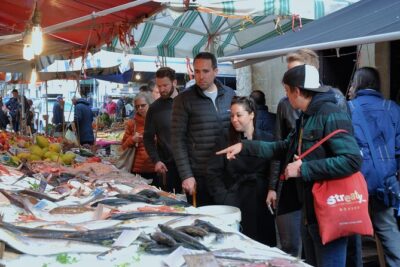
Palermo Original Street Food Walking Tour by Streaty
Read our review →
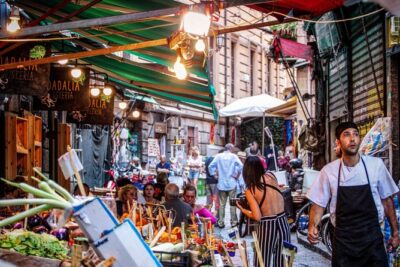
Palermo No Mafia walking tour: discover the Anti-mafia culture in Sicily
Read our review →
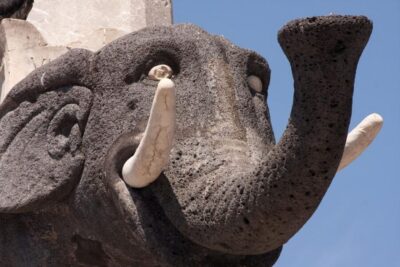
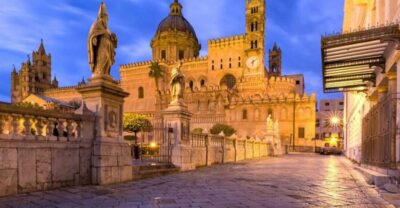
Street Food Walking Tour with Local Guide & Tasting
Read our review →Browse the lists this tour appears in