
Reviewed · SYRACUSE TOURS
Syracuse: Ortygia & Neapolis Archaeological Park Guided Tour
Syracuse’s story comes into focus when you see its ancient Greek and Roman remains alongside the streets of Ortigia, the island at the heart of the old city. This two-hour private tour links the Temple of Apollo, the cathedral and the Neapolis Archaeological Park, giving you a brisk introduction to the city’s many layers.
I like the contrast between Ortigia’s Baroque squares and seafront and the scale of Neapolis’s carved theaters. I also like that the tour is private, with a licensed guide and five language options. Giuseppe is one named guide associated with the experience, and his reported strength is keeping younger members entertained; you can’t count on having a particular guide.
The main drawback is that two hours covers a lot, while tickets and transport between Ortigia and Neapolis are not included. You’ll need to budget for both, and to plan how you’ll get from one part of the tour to the other.
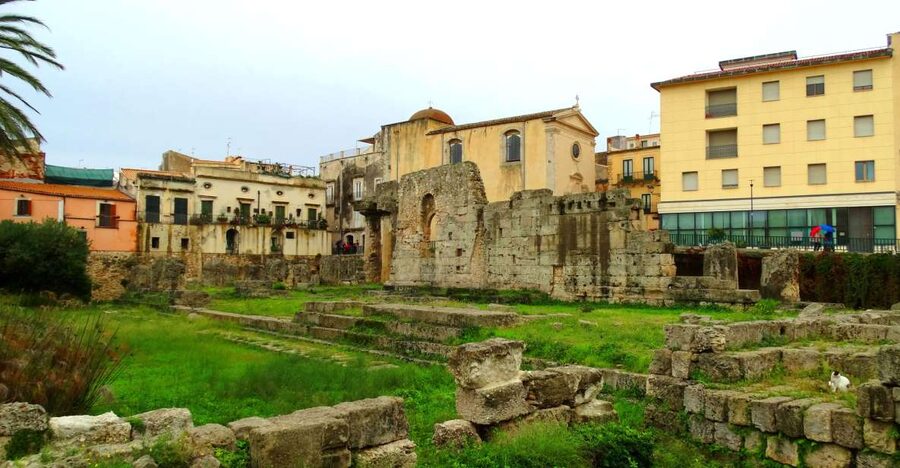
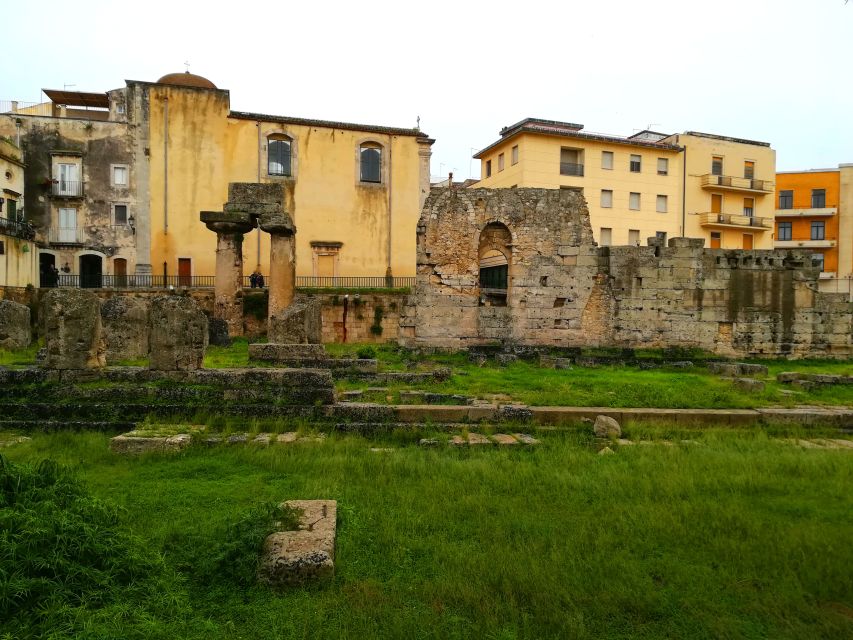
- Apollo’s temple dates to about 580 BC, making it the oldest Doric temple in Sicily.
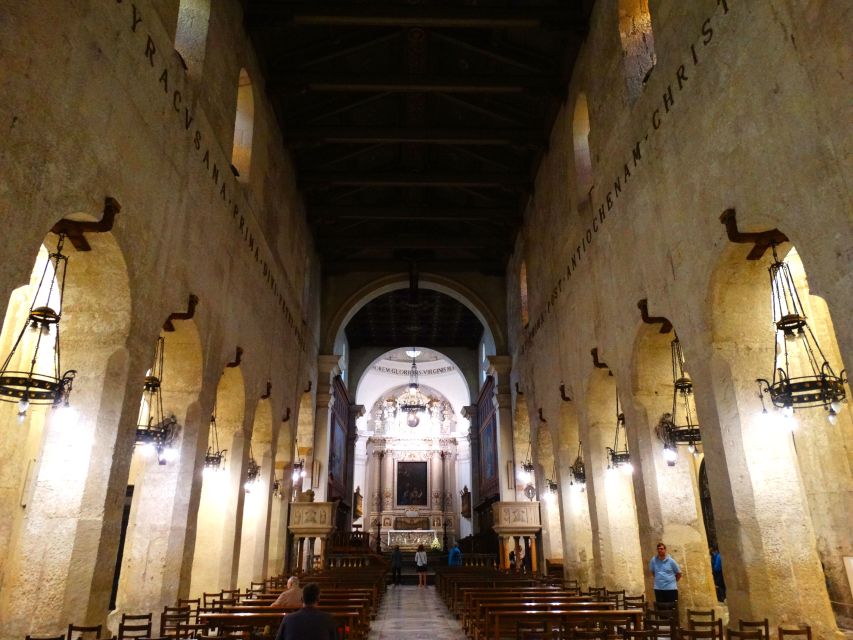
- The cathedral incorporates columns from the Temple of Athena, visible inside and outside.
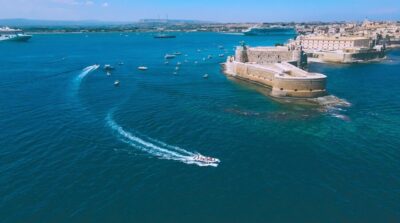
- The waterfront route ends near Maniace Castle, a fortress from the Swabian period.
- Neapolis pairs a Greek theater with a Roman amphitheater, each built for a different kind of public spectacle.
- The Ear of Dionysius is a 23-meter-high cave known for its striking echo.
Start on Ortigia at the Temple of Apollo
Meet your guide on Umbertino Bridge, by the statue of Archimedes. The bridge connects Ortigia with the mainland, and it gives the tour a clear starting point before you enter the island’s historic center. Look for the guide’s visible license badge.
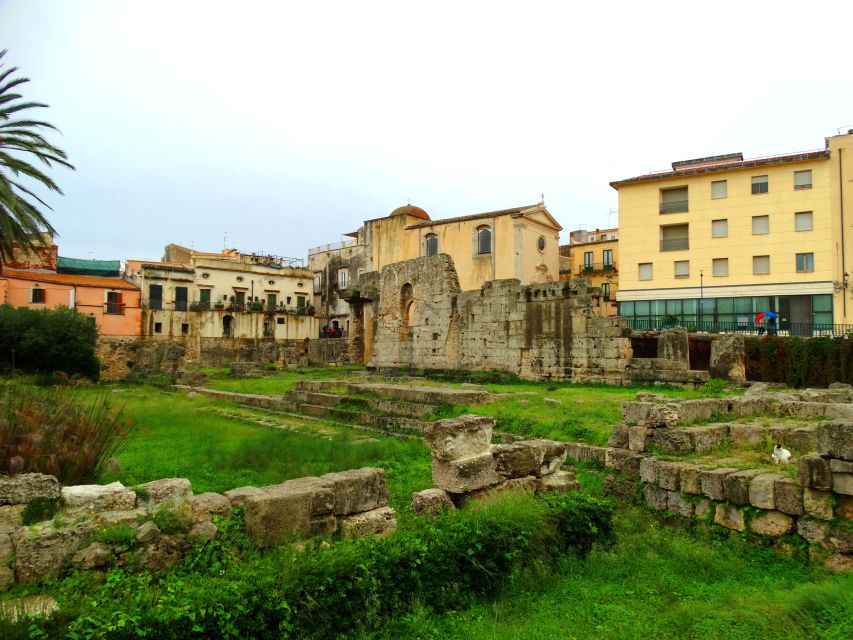
The first major stop is the Temple of Apollo, dating to about 580 BC. Its age makes it more than a photogenic ruin: it offers a tangible starting point for understanding how long Syracuse has been an important city. The remains sit among the modern streets, so you get a quick sense of how the ancient and present-day city share the same ground.
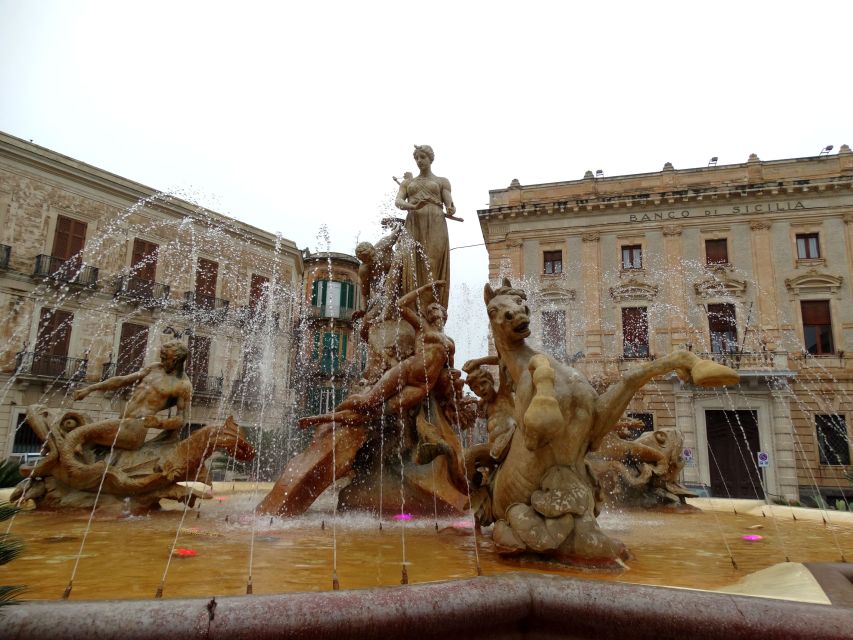
From there, the route leads toward Piazza Archimede, named for the Syracusan mathematician. Its Fountain of Diana is the square’s focal point. This is a good place to pause and take in the shift from the temple remains to the decorative public spaces of Ortigia.
The walk continues through narrow lanes to Piazza della Minerva. White limestone buildings frame the square, and the cathedral dominates it. The route is designed to make the island’s history legible through its streets and buildings, rather than treating each sight as a separate stop.
Read the cathedral’s Greek foundations
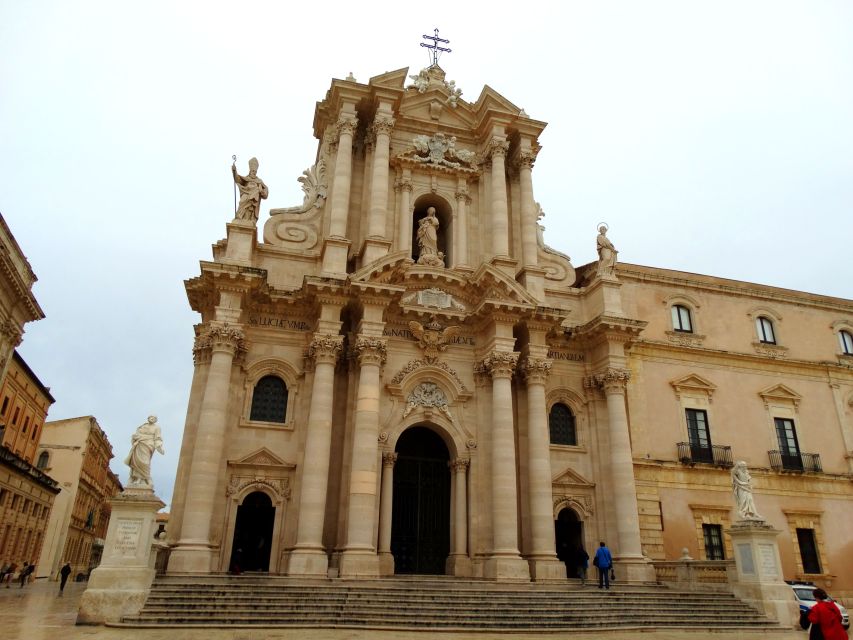
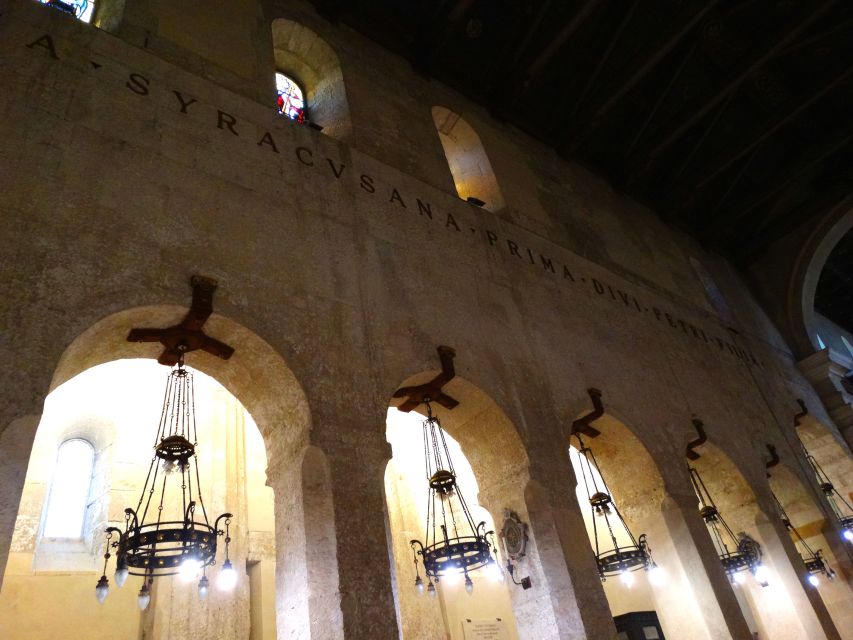
The Cathedral of Syracuse is dedicated to the Nativity of Mary Most Holy. Its imposing facade combines Baroque and Rococo styles, but the building’s older structure is the more surprising part: it was founded on the remains of the ancient Temple of Athena.
Some of the temple’s columns remain visible, including within the church. That reuse gives the cathedral a layered character you won’t get from looking only at its facade. A guided visit can help you connect the classical structure to the later Christian building, though the cathedral ticket is not included in the tour price.
Piazza della Minerva also has several other notable buildings, including Palazzo del Vermexio, which serves as the town hall, and Palazzo Beneventano. The Church of Santa Lucia alla Badia is another key stop. It houses Caravaggio’s The Burial of Saint Lucia, a major reason to include it in your walk through the square.
Admission to the Duomo is excluded, so check the current entry arrangements and cost when planning your visit. The tour description includes a cathedral visit, but the separate ticket means the guided experience and entry fee are not bundled into one price.
More guided tours in Syracuse:
- Syracuse: Ortigia and Neapolis Guided Walking Tour
★ 4.7 · 205 reviews - From Syracuse: Mount Etna Guided Morning Hike & Food Tasting
★ 4.8 · 173 reviews - Syracuse: Neapolis and Greek Theater guided tour
★ 4.5 · 160 reviews
Follow the water to Fonte Aretusa
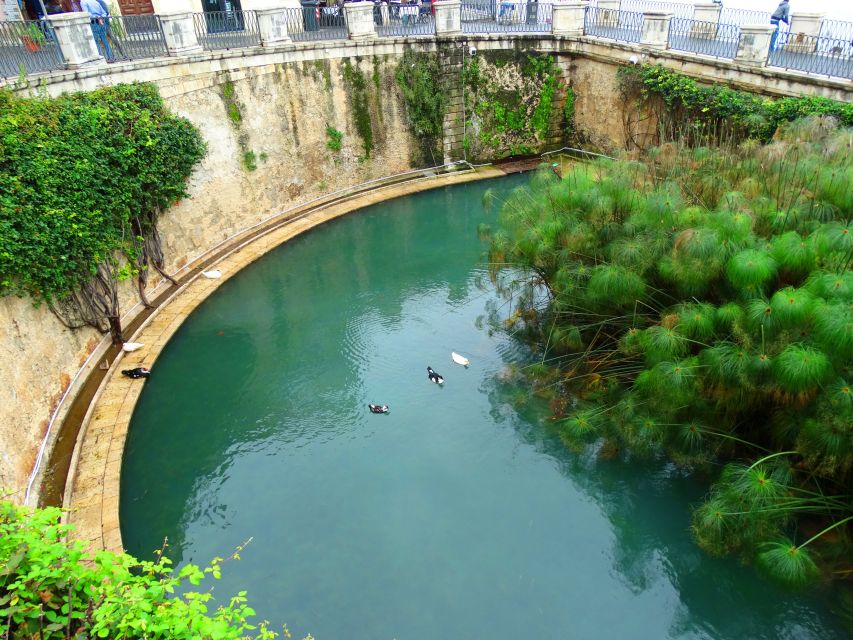
The route turns toward the sea and Fonte Aretusa, a freshwater spring on Ortigia. Fish and ducks live in the water, while papyrus grows along its edge. It’s an unusual natural feature in the middle of the historic island, and a welcome change from the stonework and formal squares.
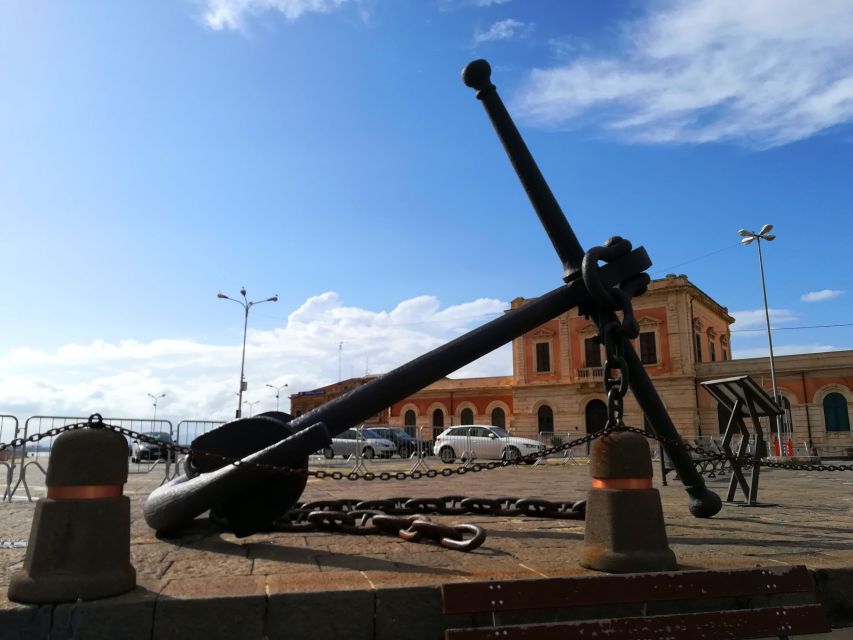
A short walk away, the Alfeo waterfront offers views of the sea around Ortigia and Maniace Castle. The castle dates to the Swabian period and has served as a prison and military barracks. It’s a useful reminder that this waterfront has had practical and strategic importance, not just scenic appeal.
The Alfeo seafront marks the end of the first part of the tour. Take a moment to enjoy the view, but keep the clock in mind: the full experience is two hours, and the archaeological park is still ahead.
Plan the move from Ortigia to Neapolis
The tour includes no transfer between Ortigia and Neapolis. You’re responsible for getting between the two areas by your own vehicle or public transport, and the cost is not included. The activity ends back at the meeting point on Umbertino Bridge, so make sure you understand how the visit to the park fits into the overall timing.
This is the practical detail most likely to affect your day. The two-hour duration covers both parts of Syracuse, but the supplied information doesn’t specify how long you have at Neapolis or how the guide coordinates the transfer. Before booking, ask the operator how the group moves between the sites and where to meet after the transfer.
Neapolis entrance tickets are also extra. Add the park admission and transport cost to the tour price when comparing options. If you want a leisurely visit to every monument, two hours may feel tight; if you want an organized overview of the main sights, the compact format can help you get oriented.
Enter the Roman amphitheater
The Neapolis visit begins near the Church of San Nicolò ai Cordari, an 11th-century church. Below it is the Roman Pool, a set of large water tanks cut into rock. Pipes carried water to the Roman amphitheater for water-based spectacles and mock naval fights.
The amphitheater itself dates to the age of Augustus. Its elliptical form was carved into the rock and arranged over three levels. It hosted different kinds of shows, including gladiator fights. Even without a long stop, the shape and scale help you picture how public entertainment worked in Roman Syracuse.
The park’s sites are close enough in theme to make a guided explanation useful. You’re moving from a water system to an arena, then to a monumental altar and the remains of a Greek theater. A guide can tie these places to the city’s changing uses over time, rather than leaving you to read each site as an isolated ruin.
Same island, a different kind of day:
- Syracuse: Boat Tour with Captain Mirko, Snorkeling & Caves
★ 4.7 · 746 reviews - Siracusa: Ortigia Boat Tour with Marine Grotto
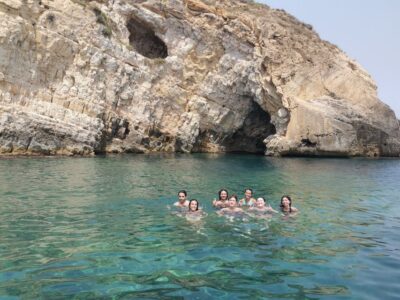
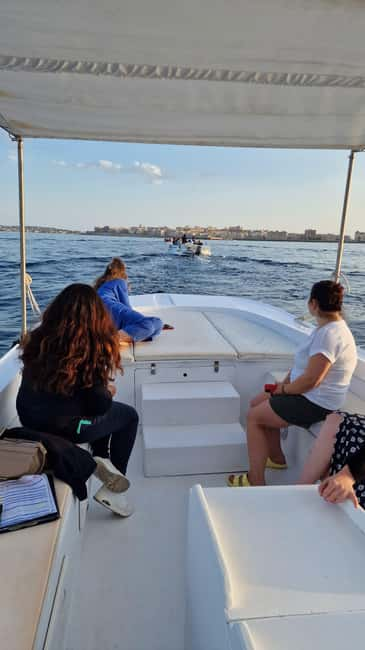
★ 4.7 · 617 reviews - Siracusa: Ortigia & Sea Caves Speedboat Tour with Swim Stop
★ 4.9 · 499 reviews - Syracuse: Neapolis Archaeological Park Small Group Tour
★ 4.7 · 350 reviews
See the Altar of Hieron and the Ear of Dionysius
Next comes the Altar of Hieron, an immense altar dedicated to Zeus, where bulls were sacrificed. Its size makes the religious and ceremonial role of the site clear, even in the absence of its original setting and activity.
The route then enters the Latomie del Paradiso, quarries from which stone was extracted. The best-known cave here is the Ear of Dionysius, a 23-meter-high cavern with an exceptional echo. The unusual shape and sound are part of what makes it memorable, and a guide can help you appreciate the space beyond its nickname.
The cave is a natural highlight, but it is still part of a larger archaeological park. If you have a particular interest in the quarries or want time to linger, the two-hour limit and the extra transfer deserve attention. You may prefer to return to the park separately if you want to explore at your own pace.
Finish at the Greek theater
The final major stop is the Greek theater, carved into the stone and described as the park’s most important monument. Built by the Greeks and later renovated by the Romans, it brings the tour’s successive periods together in one place.
The theater is a strong endpoint because it helps balance the earlier Roman sites with Syracuse’s Greek past. After the compact walk through Ortigia, you’ll have seen temples, civic squares, a cathedral built over an ancient sanctuary, and two kinds of theater. That is a lot of history to fit into a short outing, and the guide’s role is to make the connections clear.
The tour ends back at Umbertino Bridge, its starting point. Confirm how the return is arranged, since transfers are not part of the price. You’ll want to know whether the guide accompanies the group between the areas or whether you meet again at Neapolis.
Does the private-group price make sense?
The price is $369.31 per group of up to 30, not per person. That can be good value for a larger private group: split evenly, it works out to about $92.33 each for four people, or about $12.31 each for 30. For two people, it is about $184.66 each, before tickets and transport.
Those calculations are only a way to compare the guide fee. The cathedral ticket, archaeological park ticket, and transfer are all additional expenses. A smaller group may find a private guide worth the higher per-person cost for the chance to ask questions and keep the visit focused on its interests. A larger group can spread the fee more widely, though the stated group limit is 30.
The tour is available in English, Italian, French, German and Spanish. It suits you if you want a guided overview, are comfortable with a brisk two-hour schedule and can arrange the transfer. Families may appreciate the mix of fountains, caves, theaters and stories of gladiators, but the short format means there may not be time to linger at every stop.
You can reserve now and pay later, and cancellation up to 24 hours before the activity qualifies for a full refund. Those terms offer some flexibility, but they don’t change the need to plan the added admission and transport costs.
Should you book it?
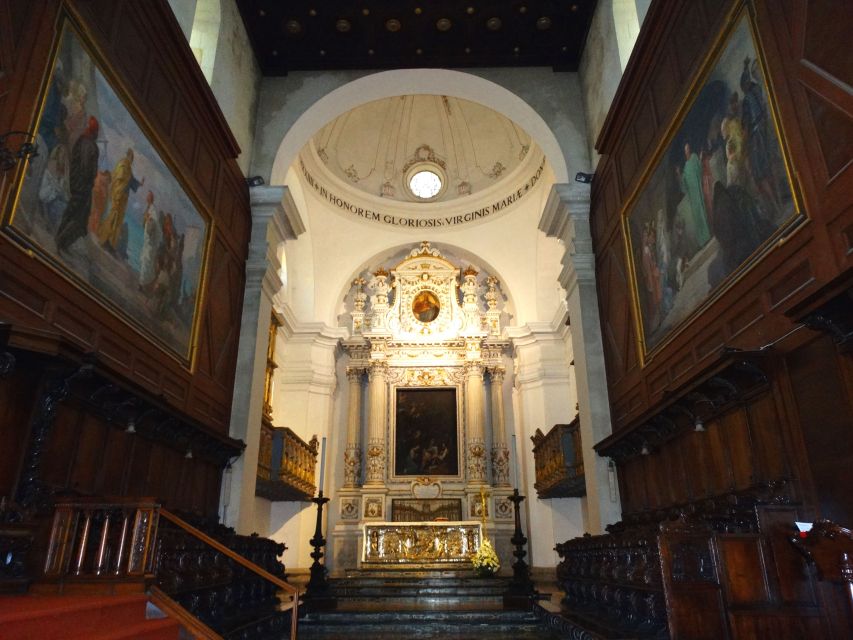
Book this tour if you want a private, guided introduction to both Ortigia and Neapolis, and you’re happy to handle the tickets and transfer separately. Its strongest draw is the range: ancient temples, a cathedral with Greek columns, a Caravaggio painting, a Roman arena and a cave with a striking echo all fit into one compact visit.
Consider another arrangement if you want a slow archaeological visit or prefer to avoid managing a transfer between areas. The price is most attractive when shared among a group, and the experience makes the most sense when you plan those extra costs in advance. For a focused first look at Syracuse, it covers an unusually broad stretch of the city’s past.
FAQ
How long is the tour?
The tour lasts two hours.
Where does the tour start?
Meet the guide on Umbertino Bridge, by the statue of Archimedes. The guide wears a visible license badge.
Where does the tour end?
It ends back at the Umbertino Bridge meeting point.
What is the price?
The listed price is $369.31 per group of up to 30 people.
Is the tour private?
Yes. The tour is described as a private group experience.
Which languages are available?
The live guide is available in English, Italian, French, German and Spanish.
Are the cathedral and archaeological park tickets included?
No. The Duomo ticket and the Neapolis Archaeological Park ticket are not included.
Is transport between Ortigia and Neapolis included?
No. You must arrange and pay for transport by your own vehicle or public transport.
Which sites are included in the tour?
The tour covers Ortigia’s Temple of Apollo, Piazza Archimede, the cathedral, Santa Lucia alla Badia, Fonte Aretusa and the Alfeo waterfront, followed by sites in Neapolis including the Greek theater, Roman amphitheater, Altar of Hieron and Ear of Dionysius.
Can I cancel for a refund?
You can cancel up to 24 hours in advance for a full refund.
Newest tours in Syracuse
- Tour of Syracuse by Ape Calessino★ 3.0 · 3 reviews
- Boat tour of the island of Ortigia and the sea caves★ 4.2 · 4 reviews
- Tecnoparco Archimede Museum Exhibition Ticket★ 4.8 · 14 reviews
- Syracuse:Snorkeling+Pillirina, Ortigia & sea caves boat tour★ 4.8 · 18 reviews
- From Taormina: Syracuse Tour with lunch in Food Market★ 4.9 · 12 reviews
- Syracuse: Sicilian Street Food Hands-On Cooking Class★ 4.9 · 38 reviews
- Syracuse: Sunset Aperitif Tour★ 4.4 · 4 reviews
- Syracuse :Private boat trip con Prosecco/Aperitivo★ 5.0 · 4 reviews
Syracuse Tours, compared.
Ortigia & Sea Caves Speedboat Tour with Swim Stop
Read our review →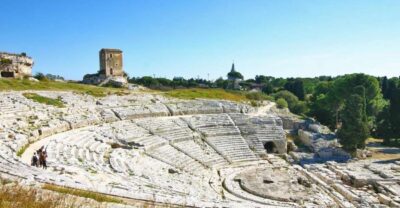
Ortigia Island and Sea Caves Boat Tour with Drinks
Read our review →
Street Food Walking Tour in Ortigia with Tastings
Read our review →
Browse the lists this tour appears in