
Reviewed · MARSALA SALT PANS TOURS
Guided tour of the Trapani Salt Pans and Salt Museum
The most unusual part of this Trapani tour is that you can touch salt forming in the production tanks, then follow the process from seawater to the crystals used in the kitchen. It takes place at the Culcasi family’s salt pans, where four generations have worked with salt.
I like the contrast between the open walk beside the pools and the close-up history inside the old salt museum. I also like that the tasting is part of the visit, with whole salt and flavored fleur de sel made by the family, rather than an afterthought in a shop.
One thing to plan for: the walk lasts about an hour, and a basic level of fitness is required. The tour is listed as wheelchair accessible, but the walking requirement may not suit everyone, so check the practical details before booking if mobility is a concern.
What makes this salt-pan visit worth your time

- Hands-on salt making: See salt forming in the tanks and collect some by hand.
- A family-run operation: The Culcasi family has worked as salt producers for four generations.
- Two distinct settings: Walk among the salt pools, then enter an ancient farmhouse museum.
- A mill dating to the 1400s: The museum visit includes an old mill and the history of salt work.
- A proper tasting: Try whole salt and fleur de sel in several flavored varieties.
- A walk in a protected area: The route passes through the WWF reserve, among protected plants and birds.
Walking the Culcasi salt pans

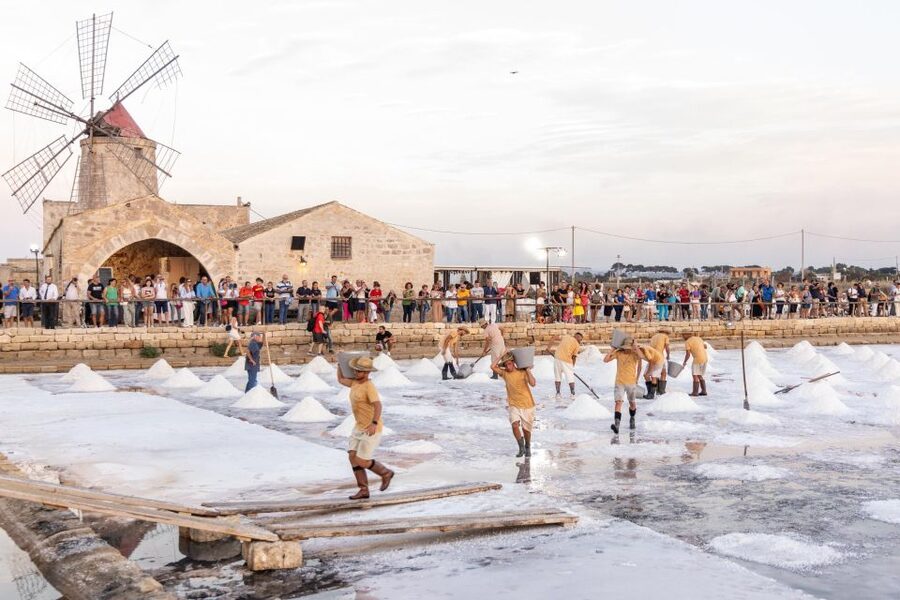
The tour begins at Salina Culcasi di Nubia, at Via Salina Chiusa, 1. The meeting point is the ticket office in the forecourt below the windmill. Look for the guide behind the salt sales counter.
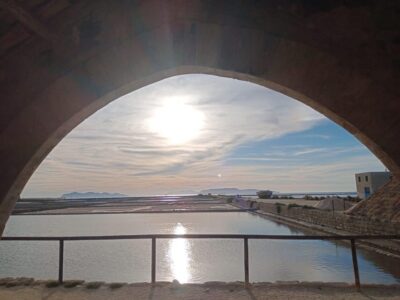
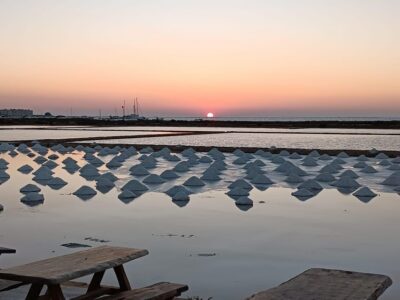
The first part is an outdoor walk around the perimeter of the salt pan. The route takes you past pools in changing shades: white salt, gray clay, pink water, and the blue of the sea. At the banks, the water can reflect the sky, giving you a good reason to slow down and look rather than hurry from one stop to the next.
This is a working salt site, not simply a scenic viewpoint. Your guide explains how seawater becomes salt, and you can see the salt forming in the tanks. The chance to collect it by hand makes the process easier to understand than a display panel alone. It also gives you a feel for the scale of the work: salt is not just a product in a jar, but the result of a process tied to sea, weather, and repeated labor.
The setting adds another layer. The salt pans sit within a WWF reserve, and the route passes protected plants and birds. The tour’s focus is salt, but the protected surroundings help explain why the site is more than an industrial stop. You are walking through a place where production and nature share the same ground.
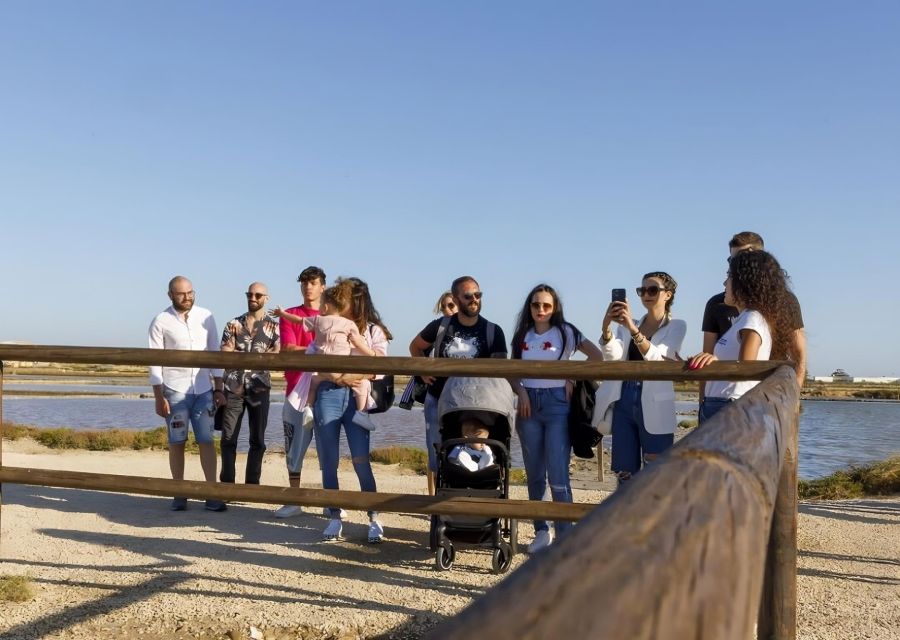
Allow for the fact that this is a walking tour, not a brief stroll from a parking area to a museum door. The activity information calls it a one-hour hike and says basic fitness is needed. Wear comfortable shoes, bring a hat, and dress comfortably. The total tour lasts 75 minutes, so the outdoor portion accounts for much of your time.
More salt pan visits in Trapani:
- Trapani: 2-Hour Salt Flats Tour
★ 4.9 · 286 reviews - Segesta, Erice and Salt Pans Full-Day Excursion from Palermo
★ 4.2 · 1,791 reviews - Trapani: Salt Pans Sunset Tour and Flamingo Way
★ 4.4 · 252 reviews
Inside the farmhouse museum and old mill
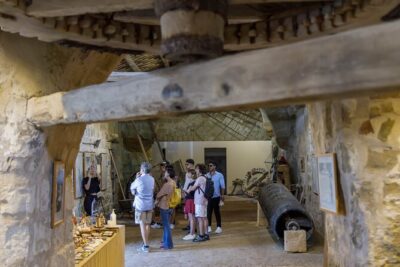
The second part moves indoors to an ancient farmhouse that houses the salt museum. Here the focus shifts from the colors and working pools outside to the people and equipment behind the trade.
The museum includes an ancient mill dating to the 1400s. That detail gives the visit a clear historical anchor, while the guide connects the mill and the salt work to the Culcasi family, who have run the operation for generations. The family story matters because it puts a human scale on an industry that can otherwise seem distant or mechanical.
Salt has long linked the sea to daily life, and the museum presents that relationship through the work of the salt pans. The visit is not just a lesson in what salt is. It is about how people have worked to produce it and how that work shaped this corner of Trapani. If you are curious about local trades and family businesses, this portion may be the most memorable part of the tour.
The museum is described as included in the European Union’s official guide. That gives the site some institutional recognition, but the appeal for most visitors is more immediate: you can see the old mill and hear how the family’s work fits into the wider history of salt and sea.
Tasting whole salt and flavored fleur de sel
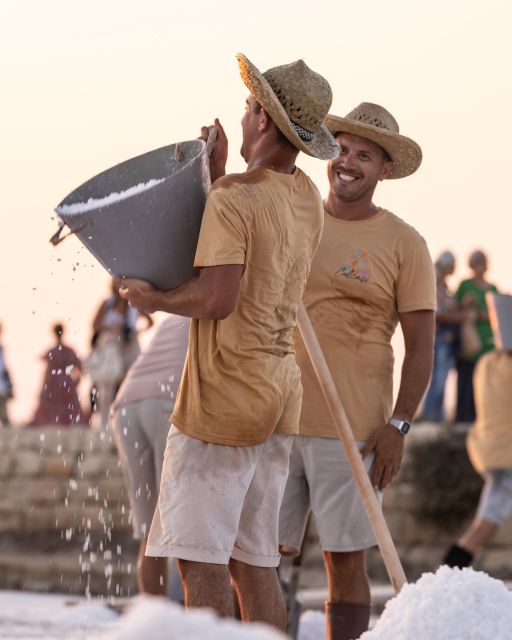
The tasting is included in the tour price. You try whole salt and fleur de sel in different aromas produced by the family. This is a useful end to the visit because it connects the explanations outdoors and in the museum with something you can taste.
The most distinctive product is the flavored fleur de sel associated with the Slow Food Presidium. The tasting is not a full meal, but it gives you a chance to compare varieties and see how the salt changes when paired with different aromas. If you enjoy cooking, this may also help you decide whether to take a product home.
The tour’s strongest appeal is the combination of explanation and sensory detail. You see the salt forming, hear how the process works, and taste the finished product. Several parts of the experience point to the same idea: salt is both a natural material and the result of skilled, sustained work.
What $21 gets you
At $21 per person, the price covers a 75-minute guided visit to the salt pans and museum, plus the tasting. That is solid value if you want a focused activity with both outdoor scenery and local history, rather than a quick photo stop.
The value depends on what you want from the outing. If you are interested in salt production, family-run trades, or the history of the area, the guide and museum make the visit more substantial than simply walking beside the pools. If you mainly want a scenic view, you may find the paid tour less compelling than a stop built around the landscape alone.
There is also an optional way to extend the visit. After the tour, you can have an aperitif with a view or eat at the restaurant. Those options are not included in the $21 price, so think of them as possible add-ons, not part of the guided experience.
The tour has a strong overall rating of 4.7 from 423 ratings. The most consistently praised details are the informative explanation of salt harvesting and the opportunity to taste several salts and flavored varieties. Those are the elements to keep in mind when weighing the price: you are paying for a guide, access to the museum, a hands-on look at production, and a tasting.
More museum visits in Trapani:
- Guided tour of the salt pans of Trapani and the Salt Museum
★ 5.0 · 188 reviews - Tile Museum – Majolica Museum – Rooms at the Genius
★ 5.0 · 85 reviews - Enchanted Castle of Sciacca – Museum Tickets
★ 3.5 · 63 reviews - Syracuse: Museum Guided Tour with Sicilian Puppet show
★ 4.1 · 27 reviews
Timing, access, and what to bring
The tour lasts 75 minutes, but the outdoor portion is described as a one-hour hike. Starting times vary, so check availability for your date. Guides speak English and Italian.
Comfortable shoes, a hat, and comfortable clothes are sensible choices for the walk. The tour is listed as wheelchair accessible, while also stating that a basic level of fitness is required. Those details may refer to different parts of the experience, so if you need step-free access or have concerns about the walking route, ask the provider what the tour involves before you reserve.
You can cancel up to 24 hours in advance for a full refund, and you can reserve now and pay later. Those terms offer some flexibility if your plans are still taking shape.
One caution is worth taking seriously: the walking requirement can be easy to miss when planning a short museum visit. The outdoor route is a central part of the experience, not a minor transfer between stops. If you are unwell, recovering, or unable to walk for about an hour, this may not be the right outing at that time.
Who will enjoy this tour most
I would recommend the tour to anyone curious about how salt is made, especially if you like visits that combine a working site with local history. Families and mixed-age groups may appreciate the variety: there is a walk, a chance to handle salt, a museum, and a tasting, rather than a long stretch of listening in one room.
It also suits visitors who want a short activity near Trapani that feels tied to the area. The four-generation family connection gives the site a personal thread, while the protected reserve and the old mill offer different reasons to pay attention. You do not need specialist knowledge of salt to follow the tour.
It is less suitable if you are looking for a fully indoor visit, have difficulty walking, or want an activity that takes only a few minutes. The pools and colors may appeal to photographers, but the value comes from the explanations and the salt-making story as much as from the view.
Should you book the Trapani salt pans tour?
Book it if you want to understand a local trade rather than just look at the scenery. The strongest reasons are the hands-on view of salt forming, the family history, the 1400s mill, and the tasting of whole salt and flavored fleur de sel.
Skip it or check carefully first if an hour of walking is a problem. At $21, it is a worthwhile, compact cultural stop for visitors with a reasonable level of fitness and an interest in food, history, or working landscapes. The walk is part of the point, so plan for it as such.
FAQ
How long is the tour?
The guided tour lasts 75 minutes. The walking portion is described as a one-hour hike.
What languages are available?
The live guide speaks English or Italian.
What is included in the ticket?
The ticket includes a guided visit to the Culcasi salt pans and salt museum, plus a tasting of whole salt and several flavored fleur de sel varieties.
Where is the meeting point?
Meet at the ticket office in the forecourt below the windmill at Via Salina Chiusa, 1. Find the guide behind the salt sales counter.
How much walking is involved?
The tour includes a walk around the perimeter of the salt pan, described as a one-hour hike. A basic level of fitness is required.
Is the tour wheelchair accessible?
The activity is listed as wheelchair accessible. It also requires a walk and a basic level of fitness, so contact the provider to clarify access needs before booking.
Can I cancel for a refund?
Yes. You can cancel up to 24 hours in advance for a full refund.
Newest tours in Trapani
- From Trapani: Favignana and Levanzo Boat Tour★ 3.9 · 27 reviews
- Segesta and Selinunte full day tour from Trapani★ 3.8 · 5 reviews
- Oil & Wine Tasting★ 5.0 · 21 reviews
- From Trapani: Favignana and Levanzo Motorboat Cruise★ 4.7 · 5 reviews
- From Trapani: Favignana and Levanzo full-day tour with lunch and aperitif★ 5.0 · 3 reviews
- From Trapani: Full-Day Sailboat Trip to Favignana & Levanzo★ 4.9 · 15 reviews
- Da Trapani: Escursione alle isole Egadi Favignana & Levanzo★ 4.9 · 7 reviews
- Favignana and Levanzo with Elisabetta II★ 4.4 · 15 reviews
Marsala Salt Pans Tours, compared.
Segesta, Erice and Salt Pans Full-Day Excursion from Palermo
Read our review →
Guided tour of the salt pans of Trapani and the Salt Museum
Read our review →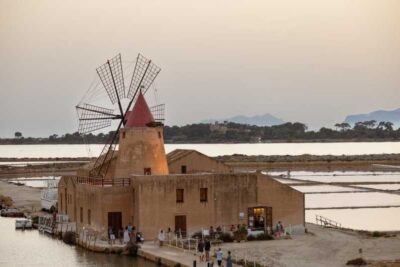

Browse the lists this tour appears in